Reviewed · LISBON TOURS
Lisbon City Center Tour – The Unmissable Lisbon
Lisbon’s best introduction may be on foot, moving from grand squares to narrow lanes, old churches, literary cafés, and the broad waterfront. This tour links the city center’s main sights without pretending that Lisbon is flat or polished at every turn. Guides such as Miriam, Ricardo, Claudia, and Hugo bring different personalities, stories, and local advice.
I like the route’s strong sense of place. You see how Restauradores, Rossio, Chiado, Bairro Alto, and the Baixa waterfront fit together, rather than checking off isolated monuments. I also like the pay-what-you-think-it’s-worth setup, which makes this a remarkably inexpensive way to get your bearings.
The main consideration is the amount of talking. Most guides keep the pace lively, but one account found the long historical explanations too dense. Add uneven streets, hills, and roughly two and a half hours of walking, and this is best for people who enjoy history delivered in generous portions.
Key points to know before you go
- A full central-Lisbon route: Start at Restauradores and finish at Praça do Comércio, passing through Rossio, Chiado, Bairro Alto, and Baixa.
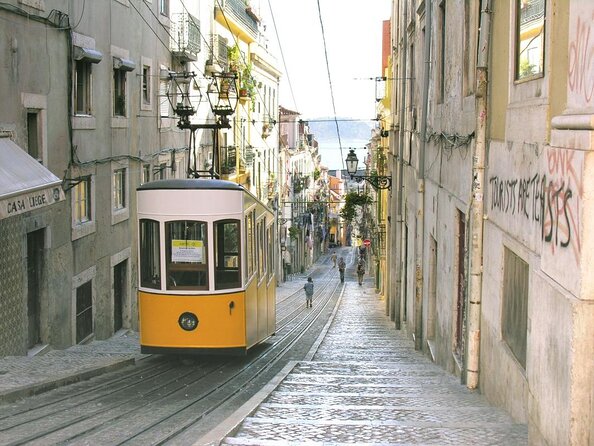
- A street-level view of the city: The walk uses alleys and streets closed to cars, not just wide avenues and major landmarks.
- Guides with distinct styles: Miriam, Ricardo, Claudia, Hugo, Mariana, Fernanda, and Silvestro are among the guides praised for humor, warmth, storytelling, and local advice.
- Useful for your first day: You receive suggestions for food, culture, photos, and places to return to during the rest of your stay.
- A low-cost format: The listed price is $3.62 per person, with the final amount left to your judgment.
- Come ready to walk: The route lasts about 2 hours 30 minutes and includes uneven streets, hills, and outdoor stops.
Why this walk works as your Lisbon orientation
I like this tour because it teaches Lisbon by sequence. You begin at a square tied to national independence, pass through places marked by religious conflict and political change, then end where the city meets the Tagus. That progression gives the sights a useful connection.
The route also shows several versions of Lisbon in a short time. You get formal squares and grand public buildings, but also a church scarred by fire, a nightlife quarter, a famous café, an opera house, and narrow streets that cars cannot use. It is a broad introduction rather than a specialist tour of one period.
The group can include up to 25 people. That is not an intimate private walk, but it is still small enough for a guide to keep a moving group together. The best experience will depend partly on the guide assigned that day. Miriam is praised for humor and storytelling, Ricardo for passion and energy, Claudia for clear structure and city advice, and Hugo for keeping the group engaged when heavy rain spoiled the views.
The tour is offered in English and uses a mobile ticket. Most people can take part, and service animals are allowed. You should expect a steady walk over old, uneven streets rather than a gentle stroll on level pavement.
A few more Lisbon options worth putting side by side
- Lisbon: Jerónimos Monastery Entrance Ticket
★ 4.1 · 14,164 reviews - Lisbon: History, Stories and Lifestyle Walking Tour
★ 4.8 · 10,902 reviews - Lisbon: Sunset Boat Party Cruise with DJ and Open Bar
★ 4.5 · 10,378 reviews
From Restauradores to the memory of 1506
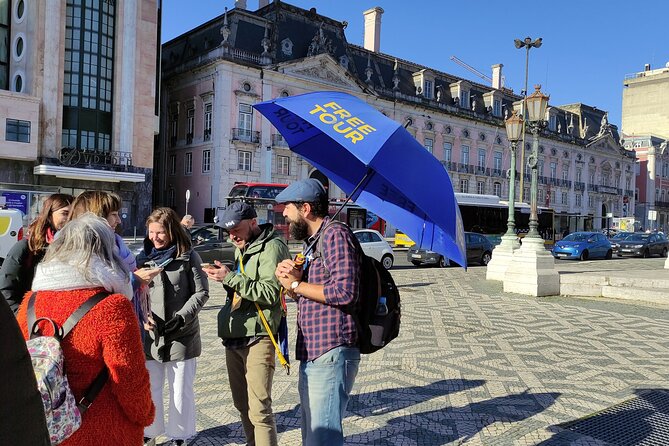
The meeting point is the Monumento dos Restauradores in Praça dos Restauradores. The square marks Portugal’s restoration of independence, and it sits at the lower end of Avenida da Liberdade, one of Lisbon’s major avenues.
The opening stop is brief, about five minutes, but it gives the guide a useful stage for explaining the city’s political story. You are not simply starting beside a metro station or hotel district. You are starting at a civic monument tied to Portugal’s national identity.
From there, the walk reaches Igreja de São Domingos. This church is described as one of Lisbon’s least adorned, yet its story gives it unusual weight. The stop focuses on peace, tolerance, and unity, themes that make more sense once you see the building’s plain interior and difficult past.
Nearby, the Memorial às Vítimas do Massacre Judaico de 1506 recalls the Jewish massacre in Lisbon. This is one of the route’s most serious moments. It asks you to look beyond tiled façades and scenic viewpoints and consider the harm caused by intolerance and religious fanaticism.
The guide may spend more time here than you expect. That can be valuable if you want history with moral context, but it may feel heavy if you came for quick facts and photographs. One practical way to handle the tour is to treat these stops as a short lesson in how Lisbon remembers its past, not merely as photo opportunities.
Rossio Square and the surprising railway station
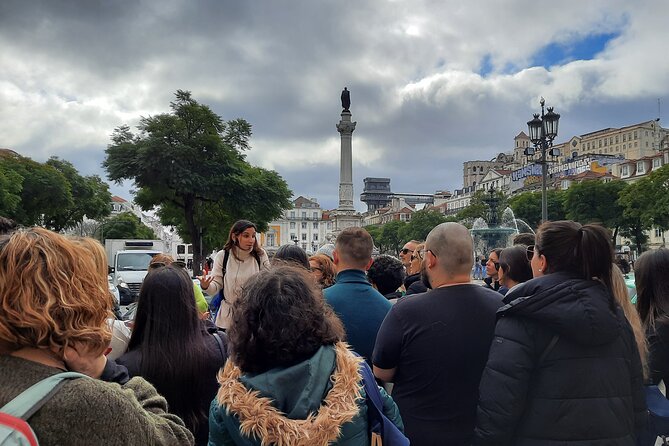
Praça Dom Pedro IV, usually called Rossio, is one of the city’s essential meeting places. Its patterned pavement, open space, and surrounding buildings make it easy to understand why it has hosted public events for centuries.
The stop lasts about ten minutes. Listen for the way the guide connects the square to changing political and social life in Lisbon. Rossio is also a useful orientation point for your own time later, since several central streets and transport links meet nearby.
The route then reaches Rossio Station, whose ornate façade often fools people into thinking it is far older than it is. The station opened in 1846 and has looked over major events in the city. The guide uses its construction date as a small surprise, a good example of how Lisbon’s older appearance can blur the line between medieval, nineteenth-century, and modern city life.
This section is especially helpful if you have just arrived. You learn where Rossio is, how it relates to Restauradores, and how the central neighborhoods begin to rise away from the square. The route is still moving, though, so do not expect a long interior visit or a detailed architectural lecture.
Chiado, Santa Justa, and the Carmo story
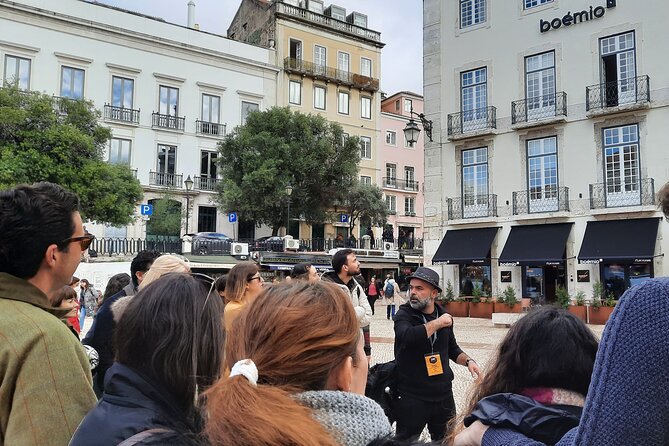
Chiado marks the entrance to one of Lisbon’s most cosmopolitan neighborhoods. The tour gives you a brief introduction before moving toward the Elevador de Santa Justa, one of the city’s most recognizable public transport structures.
The guide accesses the free area of the elevator. That matters because Santa Justa can attract queues and paid viewing arrangements. The tour does not promise a full paid ride or an extended visit, so treat this as a chance to understand the structure and see part of it without building your schedule around a long wait.
The elevator is often called a monument as much as a transport link. Its metal form and central location make it one of the easiest places to connect Lisbon’s steep streets with the lower Baixa district. You will likely appreciate the explanation more if you return later with time for a closer look.
At Largo do Carmo, the mood shifts again. This square has been a stage for passionate revolutions, and it is one of the route’s strongest history stops. The guide has about fifteen minutes here, longer than at several other locations, which gives the story room to breathe.
The nearby Carmo setting also helps explain why Lisbon’s public spaces matter. Squares are not just places to cross on the way to a restaurant. They have held protests, celebrations, upheaval, and everyday social life. Guides including Claudia have been praised for tying the stops together and ending with clear takeaways, a useful skill on a route with so many names and dates.
Same base, a completely different sort of day:
- Lisbon: Oceanário de Lisboa Entrance Ticket
★ 4.6 · 9,943 reviews - True 4Hour Private Tuk Tuk Tour: Discover Lisbon with a Local!
★ 5.0 · 8,008 reviews - Winner 2025 Undiscovered Lisbon Food & Wine Tour by Eating Europe
★ 5.0 · 6,390 reviews - Alfama Tour in Lisbon Old Town
★ 5.0 · 4,936 reviews
São Roque and the old bohemian quarter
Igreja de São Roque is one of the route’s richest interior stops. Built in the sixteenth century, it was Portugal’s earliest Jesuit church and served as the society’s home church for more than two centuries, until the Jesuits were expelled.
The church contains one of the world’s most valuable chapels. The tour listing does not promise a private visit or special access, so your time inside may depend on the group and local conditions. Still, even a short explanation helps you understand why a fairly restrained-looking church can hold such important art and religious history.
From São Roque, the walk moves into Bairro Alto. This neighborhood has more than five hundred years of history and is now best known for nightlife. The guide presents it as Lisbon’s bohemian quarter, a place where older streets and late-night culture share the same compact grid.
That contrast is useful. You see a neighborhood that changes character during the day and after dark, though the tour itself is not a nightlife outing. If you want restaurant or evening suggestions, this is a good time to ask. Several guides are praised for offering practical tips about food and cultural activities rather than stopping at dates and monuments.
Largo do Chiado provides a short transition between Chiado and Bairro Alto. It is a small stop, only about five minutes, but it helps map the relationship between the two districts. Lisbon can feel confusing when you first arrive because the neighborhoods fold into each other. This route gives you a mental map you can use later.
Coffee, Pessoa, opera, and Rua Augusta
A Brasileira is one of the walk’s most atmospheric stops. It is tied to the rise of coffee culture and to Fernando Pessoa, along with other writers and artists connected to the modernist magazine Orpheu.
The stop lasts about ten minutes. You may find the literary detail more interesting than the café itself, especially if you enjoy seeing where a city’s artistic circles gathered. The guide’s job here is to connect a familiar café with Lisbon’s creative life, not simply point out a famous façade.
The Teatro Nacional de São Carlos follows. It remains Portugal’s only theatre aimed at producing and presenting opera, choral music, and symphonic music. The exterior gives the route another change of scale, from narrow streets and cafés to a formal cultural institution.
The guide then leads you toward Rua Augusta, the lively pedestrian street of central Baixa. The route description calls it the most active and charming street in downtown Lisbon. That is a subjective judgment, but the practical point is clear: this is one of the main places where shops, restaurants, street life, and visitors converge.
You also reach the triumphal arch often used to represent Lisbon in guidebooks. The walk does not list a separate timed stop for the arch, but it is part of the route toward the waterfront. Keep your camera ready, while also watching your footing and the group. The street can become crowded, and the guide needs to keep everyone moving.
Praça do Comércio and the end at the Tagus
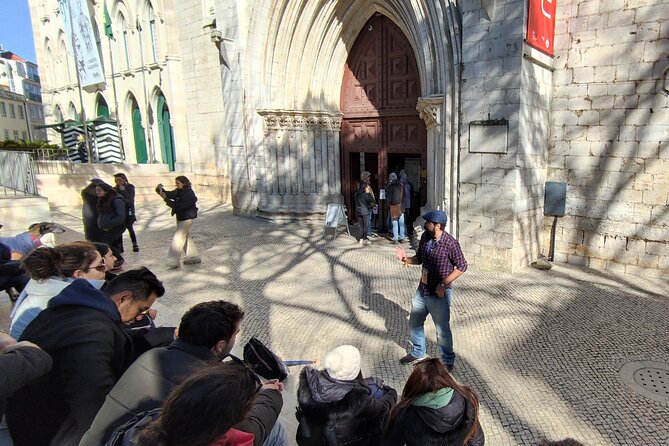
The final stop is Praça do Comércio, one of Lisbon’s great public squares. Here, the city opens toward the Tagus, and the tour ends between the arch and the equestrian statue of Dom José I.
This is a satisfying finish because it gives the walk a clear geographic endpoint. You began inland at Restauradores and moved through the central neighborhoods until the city opens to the river. The square is also a practical place to continue on your own, with plenty of room to pause, take photographs, or decide where to eat next.
Do not mistake the final stop for a complete Baixa tour. The walk gives you orientation and context, but you will still want to return to favorite places with more time. That is one of the tour’s strengths. It points out where your own second look will be worthwhile.
The end location is also convenient for asking final questions. Guides such as Fernanda have shared follow-up information through WhatsApp, including local suggestions, and have responded to questions after the walk. That level of help will vary by guide, but it is worth asking for recommendations before saying goodbye.
What the $3.62 price really means
At $3.62 per person, this is an unusually cheap introduction to Lisbon. The value is not in admission tickets, since the listed stops are free, but in the guide’s route, explanation, and advice for using the rest of your time.
The pay-what-you-think-it’s-worth model changes how you should judge the experience. You are paying for a human guide who spends more than two hours organizing the city for you. If you want a paid monument visit, transport ride, or specialist architecture tour, this will not replace it. If you want fast orientation and local suggestions, the price is hard to fault.
A small caution: the low price does not guarantee a uniform style. One guide may tell compact stories, while another may spend fifteen minutes on a difficult historical subject. The written feedback shows strong praise for humor, warmth, passion, and clear storytelling, but also one sharp complaint about too many facts and lengthy mini-lectures.
That means your ideal guide matters. If you prefer a relaxed overview, say so politely at the start or ask questions that steer the discussion toward food, daily life, and practical sightseeing. If you enjoy serious history, you may welcome the extra detail.
Timing, comfort, and weather
Plan for about 2 hours 30 minutes, though one account described the walk as a little over two hours. The route includes regular stops, but it is still a long outdoor activity with steady movement.
Wear shoes suited to uneven streets. Lisbon’s central districts are easy to explore on foot, but comfort matters more than style here. You may also want water and weather protection, since the experience requires good weather and can be canceled if conditions are poor.
Rain does not always end the experience. Hugo kept a group engaged when heavy rain and fog reduced the views, and another account still found the walk informative on a rainy day. Even so, poor weather will limit photos and may make the pavement less comfortable.
The tour is suitable for most people who can manage a city walk. The maximum group size is 25, English is the available language, and service animals are allowed. Confirmation is provided at booking, and free cancellation is available up to 24 hours before the start. Cancellations inside that period are not refunded, and changes are not accepted within 24 hours.
Who should book this Lisbon walk?
I would choose this as a first activity in Lisbon, especially after arriving in the city. It gives you a map in your head, introduces several neighborhoods, and leaves you with ideas for food, culture, and places to revisit.
It suits solo visitors particularly well because the small-group format makes conversation easier, and the low price keeps the risk minimal. Couples, families with older children, and first-time visitors can also benefit, provided everyone is ready for a steady walk and a fair amount of historical explanation.
I would think twice if you want a short, photo-focused outing or have trouble with hills and uneven paving. I would also avoid booking it immediately before another fixed appointment. The route is full of stops, and the guide may spend extra time on topics such as the 1506 massacre, the Jesuits, or Portugal’s political past.
Should you book The Unmissable Lisbon?
Yes, if you want a low-cost, English-language introduction that connects Lisbon’s main central neighborhoods. The route is unusually broad for a 2.5-hour walk, and the best guides turn that breadth into a clear story about independence, intolerance, revolution, art, nightlife, and the riverfront.
Book it early in your stay, ideally with enough time afterward to follow up on the guide’s recommendations. Go in expecting a real walking tour, not a quick circuit of landmarks. If you value local context, useful suggestions, and streets beyond the car routes, this is an excellent first step. If you prefer minimal narration, choose a different format or tell the guide at the outset that you prefer concise explanations.
FAQ
Where does the Lisbon city center tour begin?
It begins at the Monumento dos Restauradores in Praça dos Restauradores, Lisbon.
Where does the tour end?
It ends at Praça do Comércio, between the arch and the equestrian statue of Dom José I.
How long does the tour last?
The tour lasts approximately 2 hours 30 minutes.
What language is the tour offered in?
The tour is offered in English.
How much does the tour cost?
The listed price is $3.62 per person. The experience uses a pay-what-you-think-it’s-worth format.
How large can the group be?
The tour has a maximum of 25 participants.
Does the tour include paid admission to the attractions?
The listed stops have free admission. At the Elevador de Santa Justa, the tour accesses the free area of the elevator.
Is the tour suitable for most people?
Yes. Most people can participate, and service animals are allowed. You should be prepared for a steady walk over uneven city streets.
What happens if the weather is poor or I need to cancel?
You can cancel at least 24 hours before the start for a full refund. If poor weather causes the tour to be canceled, you will be offered another date or a full refund. If the minimum number of participants is not reached, you will also be offered another date, another experience, or a full refund.
The newest listings around Lisbon
- The Real Lisbon Street Art Private Guided Tour by Minivan★ 4.8 · 49 reviews
- Lisbon: Historical Walking Tour with Jeronimos Monastery★ 4.5 · 71 reviews
- Lisbon: Port Wine Tasting at Taylor’s Shop and Tasting Room★ 4.6 · 490 reviews
- Lisbon: Tagus River Cruise With Brunch★ 3.2 · 73 reviews
- South Lisbon: 3-Hour Christ the King Electric Bike Tour★ 4.8 · 97 reviews
- Oeiras Coast: Stand Up Paddleboarding near Lisbon★ 4.9 · 56 reviews
- Small Group Walking Tour of Belém★ 4.9 · 80 reviews
- Lisbon: 3-Hour Secret Food Tour★ 4.7 · 53 reviews
Lisbon Tours, compared.

Sunset Boat Party Cruise with DJ and Open Bar
Read our review →

True 4Hour Private Tuk Tuk Tour: Discover Lisbon with a Local!
Read our review →
Winner 2025 Undiscovered Lisbon Food & Wine Tour by Eating Europe
Read our review →