Reviewed · LISBON TOURS
Alfama Tour in Lisbon Old Town
Alfama is Lisbon at its most atmospheric: a maze of steep lanes, old fountains, tiled walls, small squares, and lookout terraces above the Tagus. This 2.5-hour walking tour gives the district a clear shape, linking Roman, Moorish, Jewish, imperial, and modern Portuguese stories as you climb through the oldest part of town.
I like two things here. First, the route reaches the classic viewpoints at Portas do Sol and Santa Luzia, but it also pauses at less obvious corners such as Largo de São Rafael and the History of Lisbon mural. Second, the guides bring personality to the walk. Cecilia sings, Hugo explains Fado and saudade, and guides such as Claudia, Nina, Belen, and Fernanda are praised for their humor and clear storytelling.
The catch is the terrain. Alfama means hills, uneven paving, and stairs, and some people find the climb tough. The start at Casa dos Bicos can also be confusing when several walking groups gather nearby, so arrive early and look for the blue umbrellas.
Key points to know before you book

- Tip-based pricing keeps the upfront cost low: The listed price is $3.62 per person, but a tip is expected at the end and should reflect the quality of the guide and the length of the walk.
- The route covers 12 meaningful stops: You see viewpoints and famous churches, but also fountains, old walls, a mural, and quiet Alfama squares.
- Strong local storytelling is the main attraction: Guides explain Fado, Lisbon’s popular saints celebrations, colonial history, migration, architecture, and daily life.
- Expect serious hills and stairs: Comfortable walking shoes are essential, and a moderate level of fitness is required.
- The meeting point is near Casa dos Bicos: Find the blue umbrellas at R. dos Bacalhoeiros 12A, not far from Lisbon’s riverfront.
- The tour ends away from the starting point: You finish near St. Anthony’s Church, close to Lisbon Cathedral and the central Alfama area.
Why Alfama makes a good walking tour

You can wander Alfama alone, but its lanes often make more sense once someone explains what you are seeing. The district survived the 1755 earthquake better than much of central Lisbon, and its tangled streets preserve traces of several eras. A guide helps connect the stone walls, fountains, churches, balconies, and music traditions into one story.
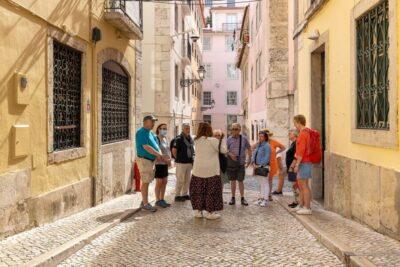
This is not a museum tour. You spend most of the time outdoors, stopping in plazas, at viewpoints, and beside buildings while your guide talks. That format works well in Alfama because the neighborhood itself is the exhibit.
The group can include up to 25 people, though some departures are much smaller. A small group makes it easier to hear and ask questions. The guides are expected to speak English, and the strongest ones adjust the pace to the group. Claudia, for example, has been praised for stopping in shaded spots and allowing time for pictures and restroom breaks. Belen kept the pace manageable for a participant in their late seventies.
The walk begins at 3:30 pm. That timing gives you a useful afternoon introduction to Alfama, with enough time afterward for dinner, Fado, or another viewpoint. A morning option is also advertised, so check the available departure when booking.
A few more Lisbon options worth putting side by side
- Lisbon City Center Tour – The Unmissable Lisbon
★ 5.0 · 22,234 reviews - Lisbon: Jerónimos Monastery Entrance Ticket
★ 4.1 · 14,164 reviews - Lisbon: History, Stories and Lifestyle Walking Tour
★ 4.8 · 10,902 reviews
Starting at Casa dos Bicos and Lisbon’s riverfront
The first meeting point is Casa dos Bicos, at R. dos Bacalhoeiros 12A. The building is easy to recognize by its diamond-shaped stone façade, but the practical landmark for this tour is the blue umbrellas.
You spend about 15 minutes here before setting off. Admission to the museum is not included, and the tour does not function as an indoor visit. Think of this stop as an orientation point, where your guide sets up Lisbon’s long story before leading you uphill.
The meeting area can be busy, and one person had trouble identifying the correct group because several churches and tours were close together. Give yourself extra time. If you see more than one walking group, ask specifically for the Alfama tour with the blue umbrellas rather than relying only on a map pin.
Ancient water at Chafariz D’El Rei
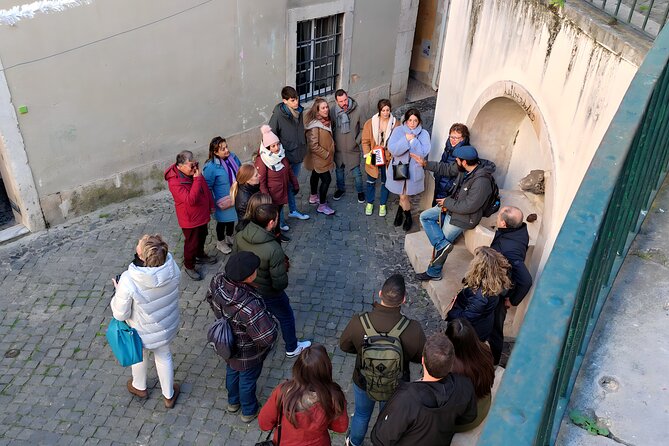
The next stop is Chafariz D’El Rei, usually described as one of Lisbon’s earliest public fountains. It dates to the 13th century and drew on water from the Alfama hillside.
You only spend about 10 minutes here, but the stop helps explain why people settled in this part of Lisbon. Water shaped the district’s growth, and a public fountain was once a practical center of neighborhood life, not simply a decorative feature.
From here, the tour shifts away from big landmarks and into Alfama’s smaller public spaces. That change is one of the route’s strengths. You are not being marched from one famous building to another. You are watching how the district works street by street.
Alfama’s central squares and old walls

Largo do Chafariz de Dentro was once known as Chafariz dos Cavalos, or Horse Fountain. It is presented as Alfama’s central plaza, and its name reflects its position within the walls associated with the Fernandina fortifications.
The stop lasts around 10 minutes. It gives your guide room to explain the old defensive boundaries and the changing role of Alfama’s public spaces. You may find this less visually dramatic than the viewpoints later in the walk, but it is important for understanding the neighborhood’s structure.
At Largo de São Rafael, the route follows memories of older Alfama beside an ancient wall. Then comes Largo do Salvador, where the group sits and listens to stories about customs and cultural traditions.
These pauses matter. Alfama can feel like a pretty maze if you only photograph it. Sitting down while your guide explains how habits and communities shaped the lanes gives the streets more meaning.
Same base, a completely different sort of day:
- Lisbon: Sunset Boat Party Cruise with DJ and Open Bar
★ 4.5 · 10,378 reviews - Lisbon: Oceanário de Lisboa Entrance Ticket
★ 4.6 · 9,943 reviews - True 4Hour Private Tuk Tuk Tour: Discover Lisbon with a Local!
★ 5.0 · 8,008 reviews - Winner 2025 Undiscovered Lisbon Food & Wine Tour by Eating Europe
★ 5.0 · 6,390 reviews
Igreja de São Miguel and Lisbon’s popular saints
Igreja de São Miguel and its square are connected with Lisbon’s Popular Saints festivities. These June celebrations are a major part of the city’s calendar, and the square becomes one of the places where local tradition comes into view.
The tour allows about 15 minutes here. This is a good point to ask questions about neighborhood life, festivals, and the difference between seeing Alfama as a historic quarter and seeing it as a living community.
Several guides are praised for making these subjects easy to follow. Fernanda is described as funny and engaging, while Joao is remembered for keeping the walk pleasant as well as informative. The names may change from one departure to another, but the experience depends heavily on who leads your group.
The mural that tells Lisbon’s story

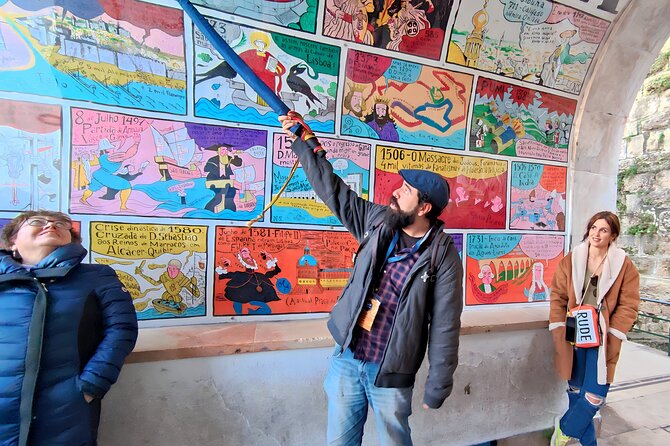
The History of Lisbon mural by Nuno Saraiva is a short stop, about 10 minutes. It adds a modern visual layer to a route otherwise filled with old stone, churches, and tiled façades.
A mural can be easier to read with a guide beside it. Instead of passing by as street art, it becomes a compact way to consider Lisbon’s past and the ways the city presents its own story.
This is also a reminder that Alfama is not frozen in time. The district contains old walls and new creative work, historic traditions and present-day residents. The tour does a good job of moving between those layers rather than treating the neighborhood as a stage set.
Climbing toward Santo Estêvão
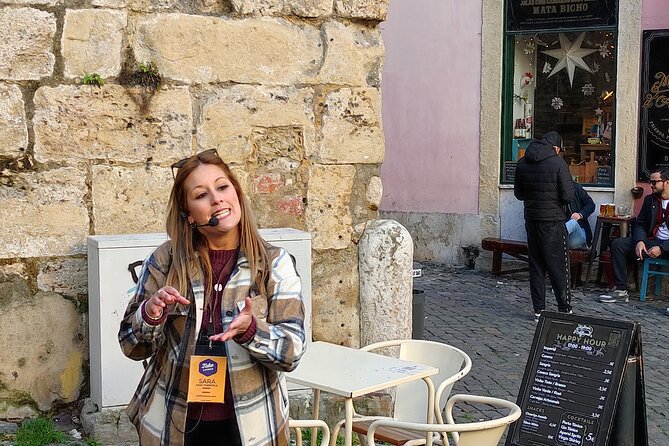
The route then heads through Alfama’s maze toward Miradouro de Santo Estêvão. The exact pace can affect how much time you spend here, and the climb may include steep streets and stairs.
The viewpoint is linked with the Church of Santo Estêvão. It is not as famous as Portas do Sol or Santa Luzia, which is part of its appeal. You get a quieter look at the district and a chance to catch your breath.
This is where the physical side of the outing becomes clear. The route is not a flat stroll along the river. Wear shoes with a firm sole, bring water, and do not plan another demanding activity immediately afterward. Guides often slow down for the group, but they cannot remove the hills.
The postcard views at Portas do Sol

Miradouro das Portas do Sol is one of Alfama’s great balconies. From here, the city opens toward the Tagus, with Alfama spreading below and around you.
The stop is scheduled for about 10 minutes. You will want photographs, but listen to the guide before rushing to the rail. The view helps explain why Alfama’s lanes climb so sharply and why the neighborhood has become one of Lisbon’s most photographed areas.
This viewpoint can be busy. The advantage of joining a tour is that you get context without having to work out the geography yourself. The disadvantage is that the group may need to move on before you have finished taking pictures.
Santa Luzia, tiles, and the feel of old Lisbon
Miradouro de Santa Luzia is another classic terrace, known for its romantic setting. It is a natural place to pause and take in Lisbon’s rooftops, river views, and decorative tilework.
The route allows about 10 minutes here. I would treat this as one of the tour’s visual highlights, but not the whole reason to book. You can reach the viewpoint independently. What you cannot easily reproduce on your own is the sequence of stories that connects the view with Alfama’s music, religion, architecture, and social history.
The district’s narrow lanes also show why comfortable shoes matter. Smooth-looking paving can still be uneven, and the combination of slopes and steps is tiring after several stops.
Lisbon Cathedral and St. Anthony’s Church
Lisbon Cathedral, or Sé de Lisboa, is the oldest and most important church in the city, with construction beginning in the 12th century. The tour spends about 15 minutes outside. Entry is not included, and the stated admission price is €5.
That is useful to know before you arrive. If you want to see the interior, plan a separate visit and allow extra time. The walking tour itself focuses on the cathedral’s place in Lisbon rather than providing an indoor church visit.
The final stop is the Church of St. Anthony, dedicated to Lisbon’s much-loved saint. The tour ends here after another 15-minute visit. This location works well because it leaves you close to several central sights, restaurants, and transport connections, although the activity does not return you to Casa dos Bicos.
Fado, ginjinha, and the human side of the tour
The best guides add local details that are difficult to get from a guidebook. Hugo has been singled out for explaining Fado as more than a style of music. His discussion of saudade, the Portuguese feeling of longing and absence, gives the music a stronger emotional setting.
Cecilia is known for singing during the tour, which can make the connection between Alfama and Fado feel immediate. Other guides have introduced ginjinha, Lisbon’s sour-cherry liqueur, sometimes served in a small chocolate cup. This is not listed as a formal included refreshment, so do not treat it as part of the ticket price. If offered, expect to pay a small additional amount.
The route may also touch on Roman remains, Moorish lanes, the former Jewish quarter, colonialism, dictatorship, migration, and the city’s changing communities. These subjects require a thoughtful guide. The strongest guides keep the story clear without turning the walk into a lecture.
Is the $3.62 price really good value?
At $3.62 per person, the advertised cost is unusually low for a 2.5-hour guided walk. The reason is that this is a fully tip-based experience. A tip at the end is welcomed and expected, so your real cost depends on what you feel the guide’s time and work were worth.
This system can be good value if you want a low-risk introduction to Alfama and are prepared to tip fairly. It also gives you a way to reward a guide who answers questions, manages the hills well, and adds useful suggestions for the rest of your Lisbon stay.
Do not book it expecting a fully paid, no-extra-cost excursion. Food and drinks are not included, and the cathedral admission costs extra. The tour’s main value is the guide, the route, and the explanations.
The activity is rated 4.9 from 4,936 ratings, with 99 percent of participants recommending it. That points to a consistently strong experience, though one serious complaint involved a cancellation after the minimum group size was not met and poor follow-up about another date. The terms say that a cancellation caused by the minimum not being reached should result in another option or a full refund, so keep an eye on messages before departure.
Who should book this Alfama walk?
I would choose this tour if you want a first orientation to Lisbon’s oldest district, enjoy stories more than formal museum visits, and like learning from a local guide. It is especially useful early in your stay because the guide provides suggestions for food, music, viewpoints, and other things to do afterward.
It suits adults, older children, and anyone with moderate walking ability. A participant aged 79 managed the route when the guide adjusted the pace, but that does not make it easy terrain. If steep grades and stairs are a problem, you may prefer to explore the lower streets at your own speed.
The tour also suits repeat visitors who want a stronger sense of Alfama’s cultural life. You will still see the standard viewpoints, but the fountains, mural, small squares, festivals, and Fado stories give the walk more substance than a basic photo stop.
Final verdict: a strong choice with one clear warning
Book this Alfama tour if you want good storytelling, local context, and a broad introduction to Lisbon’s oldest neighborhood at a very low upfront price. The route covers the essential viewpoints and several less obvious stops, while guides such as Hugo, Cecilia, Claudia, Nina, Belen, and Fernanda have shown how much personality can shape the experience.
Skip it if you dislike hills, want a fully private tour, or need a guaranteed indoor visit to the cathedral. Also arrive early enough to find the blue umbrellas and remember that the tip is part of the bargain. For most visitors who can handle the climb, this is a practical and rewarding way to meet Alfama before returning on your own for a slower wander.
FAQ
How long does the Alfama tour last?
The walk lasts approximately 2 hours and 30 minutes.
Where does the tour begin?
It begins at R. dos Bacalhoeiros 12A, 1100-070 Lisboa, near Casa dos Bicos. Look for the blue umbrellas.
Where does the tour end?
The tour ends at a different location, near the Church of St. Anthony and the final Alfama stops.
Is the tour physically demanding?
Yes. You should have a moderate level of fitness because Alfama has steep grades, uneven streets, and many stairs. Comfortable walking shoes are strongly recommended.
Is Lisbon Cathedral entry included?
No. The tour does not go inside Lisbon Cathedral. Entry is listed at €5 and is paid separately.
What happens if I need to cancel?
You can receive a full refund if you cancel at least 24 hours before the start time. Cancellations or changes made within 24 hours are not refunded.
The newest listings around Lisbon
- The Real Lisbon Street Art Private Guided Tour by Minivan★ 4.8 · 49 reviews
- Lisbon: Historical Walking Tour with Jeronimos Monastery★ 4.5 · 71 reviews
- Lisbon: Port Wine Tasting at Taylor’s Shop and Tasting Room★ 4.6 · 490 reviews
- Lisbon: Tagus River Cruise With Brunch★ 3.2 · 73 reviews
- South Lisbon: 3-Hour Christ the King Electric Bike Tour★ 4.8 · 97 reviews
- Oeiras Coast: Stand Up Paddleboarding near Lisbon★ 4.9 · 56 reviews
- Small Group Walking Tour of Belém★ 4.9 · 80 reviews
- Lisbon: 3-Hour Secret Food Tour★ 4.7 · 53 reviews
Lisbon Tours, compared.

Lisbon City Center Tour – The Unmissable Lisbon
Read our review →

Sunset Boat Party Cruise with DJ and Open Bar
Read our review →

True 4Hour Private Tuk Tuk Tour: Discover Lisbon with a Local!
Read our review →
Winner 2025 Undiscovered Lisbon Food & Wine Tour by Eating Europe
Read our review →