
Reviewed · WALKING TOURS
Best of Lisbon Walking Tour: Rossio, Chiado & Alfama
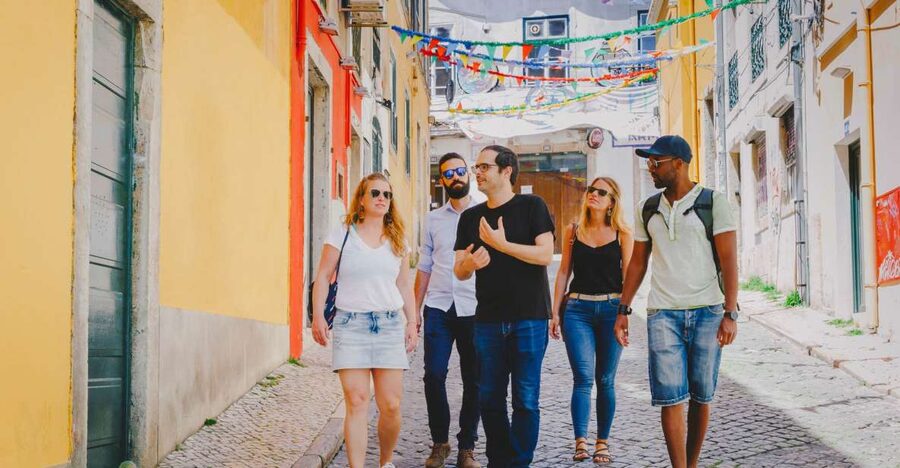
Lisbon’s story comes alive on this walk because the route links grand squares with ordinary lanes. You move from Rossio and Baixa to Chiado and Alfama, seeing how earthquake planning, revolution, music, food, and daily life fit together. I especially like the pastel de nata tasting and the stop for a savory snack with wine in Alfama. One thing to consider: three hours on foot can feel demanding if hills, long walks, or standing while listening are difficult for you.
I also like the way the tour connects places that can seem separate on a map. At Carmo Square, the guide explains the Carnation Revolution, while in Alfama you get a closer sense of Fado and old Lisbon. The main drawback is that entrance fees are not included, and the tour focuses on seeing sites from outside rather than touring their interiors.
Key points to know before you book

- Rossio to Praça do Comércio: Follow Lisbon’s central spine from the statue of Dom Pedro IV to the city’s former riverfront entrance.
- Three major neighborhoods: See Baixa, Chiado, and Alfama in one guided route, with context for how each area differs.
- Revolutionary history: Carmo Square is the setting for an explanation of the 1974 Carnation Revolution.
- Two food moments: Your inclusions are one pastel de nata, one additional snack, and one wine tasting.
- Strong guide element: Guides including Filipa, Daniel, Maria, Carlos, Martin, and Joana are praised for warmth, humor, clear explanations, and local advice.
- Good first-day choice: The route helps you get your bearings and gives you ideas for restaurants, shortcuts, and places to return to later.
Starting with Rossio Square and Lisbon’s old center

Meet beside the statue of Dom Pedro IV in Rossio Square. This is a sensible starting point because you are right in the middle of central Lisbon, surrounded by major streets, shops, monuments, and public squares.
Your guide begins by placing Rossio between old and new Lisbon. The square is not just a photo stop. It helps you understand how the city functions as a meeting place and a route between the river, Baixa, Chiado, and the northern districts.
Look toward Rossio Railway Station for its ornate neo-Manueline facade. The building gives the opening stretch a strong visual moment, even if you do not go inside. The guide uses it as a way to discuss Portuguese design and the city’s changing public spaces.
From there, the group passes through St. Dominic’s Square. This short stop adds a more personal note to the grand setting of Rossio. The route does not treat Lisbon as a string of monuments only. It also points you toward the city’s social and political life.
At Restauradores Square, you see the obelisk marking Portugal’s restoration of independence from Spain. That detail matters because it gives the square a clear historical purpose. Instead of simply photographing a monument, you learn why it was placed there and what national memory it represents.
More Walking Tours in Lisbon
- Lisbon: History, Stories and Lifestyle Walking Tour
★ 4.8 · 10,902 reviews - Best of Lisbon Small-Group Guided Walking Tour
★ 5.0 · 4,869 reviews - Lisbon: Food and Wine Small Group Walking Tour
★ 4.9 · 4,082 reviews
Carmo Square and the story of the Carnation Revolution
Carmo Square is one of the most meaningful stops. Here, the guide explains the Carnation Revolution of 1974, which ended 48 years of dictatorship in Portugal.
This is a useful point in the tour because it brings modern Portuguese history into the open. Lisbon is often presented through explorers, tiled facades, trams, and pastries. The story of dictatorship and peaceful political change gives you a fuller picture of the country you are visiting.
The stop also allows time for photographs and views along the walk. Guides such as Daniel, Maria, Filipa, and Carlos are repeatedly praised for making historical material easy to follow without turning the walk into a lecture. That balance is important. You get dates and events, but also stories and explanations that help you remember them.
The tour does not include entrance fees or guided visits inside attractions. At Carmo, the value comes from the setting and the explanation rather than an extended interior visit. If you want to explore particular monuments at length, plan a separate visit.
Chiado, where old cafés meet theaters and bookshops

The route continues into Chiado, one of Lisbon’s more elegant central neighborhoods. Your guide points out old cafés, boutiques, theaters, and small bookstores. This part of the walk changes the mood from political squares and monumental buildings to streets shaped by shopping, culture, and city life.
I like this section because it helps you notice the difference between Lisbon’s districts. Chiado feels polished and literary, while Baixa follows a more formal street plan, and Alfama feels older and more winding. Seeing them in one outing gives you a useful mental map.
The guide’s local suggestions can be especially helpful here. Several guides, including Diane’s guide Carlos and guides named Maria, Joana, and Martin, are praised for restaurant advice and ideas for exploring after the tour. You can ask questions as you go, so bring a short list of things you want to find during the rest of your stay.
The Chiado portion is mainly a guided walk and pass-by experience. Do not book this expecting long shopping stops or time inside cafés and theaters. The point is to understand the neighborhood and see its character while moving through the center.
Baixa and the city rebuilt after the earthquake

Baixa gives the tour a strong lesson in city planning. The neighborhood was rebuilt after the eighteenth-century earthquake according to new rules for streets, buildings, and safety.
Your guide explains how this planned area differs from the older parts of Lisbon. The straight streets and spacious squares are easier to understand once you know that Baixa was designed as a response to disaster rather than growing slowly over many centuries.
This is one of the tour’s most useful pieces of context. You may notice the layout while walking, but the explanation tells you why it looks that way. The stop also helps you read Lisbon later, especially when you move from Baixa’s ordered streets into Alfama’s narrow lanes.
Baixa is where the first food tasting takes place. The stated inclusion is one pastel de nata, the familiar Portuguese egg custard tart. This is a small serving, not a full meal, but it gives you a traditional taste without adding much time to the route.
At $23 per person, the food matters to the value calculation, but it is not the main reason to book. The real benefit is a guided introduction to several central neighborhoods, with the pastry and wine making the walk feel more like a cultural outing than a basic orientation stroll.
Same base, a completely different sort of day:
- Lisbon City Center Tour – The Unmissable Lisbon
★ 5.0 · 22,234 reviews - Lisbon: Jerónimos Monastery Entrance Ticket
★ 4.1 · 14,164 reviews - Lisbon: Sunset Boat Party Cruise with DJ and Open Bar
★ 4.5 · 10,378 reviews - Lisbon: Oceanário de Lisboa Entrance Ticket
★ 4.6 · 9,943 reviews
Viewpoints and the practical side of a walking route

The itinerary includes more than one viewpoint stop. These pauses give you time for photographs and a chance to look across Lisbon rather than only at street level.
Exact viewpoint names are not specified, so do not book this expecting a particular famous overlook. Instead, think of these stops as short breaks that add visual variety to the history and neighborhood explanations.
Comfortable shoes and comfortable clothing are important. You will walk for about three hours, with a route that includes central streets, neighborhood lanes, viewpoints, and Alfama. A guide may also offer shortcuts up the hills, as Carlos did for one group, but this remains an active walking experience.
The pace appears to be a strong part of the experience. Filipa was praised for pacing the route well, while other guides allowed extra time when conversation and questions called for it. The tour can sometimes run beyond three hours, but that is not guaranteed, so leave room in your schedule if you have a fixed lunch booking or another activity.
Alfama, Fado, and a final taste of Lisbon

Alfama is the most atmospheric part of the walk. This is Lisbon’s old Moorish neighborhood, with winding streets and lanes that feel very different from Baixa’s planned grid.
Here, the guide introduces you to Fado, Lisbon’s distinctive musical tradition. The tour gives you an up-close encounter with the neighborhood and explains the cultural setting around the music. It is important to keep expectations clear: this is not advertised as a full Fado performance, so you should expect explanation and atmosphere rather than a concert.
The food and wine tasting in Alfama adds a friendly pause. The included snack may be a codfish cake, based on the experience described by several participants, and the wine may include green wine. The formal inclusions are one snack tasting and one wine tasting, so the exact serving should not be treated as a full meal or a tasting menu.
This final stretch is where many of the guide personalities seem to matter most. Daniel is praised for humor and for bringing a mixed group together. Maria is praised for energy and local insight. Jose Luis is praised for combining history with food stops, while William and Ricardo are remembered for making the walk last longer without making it feel rushed.
You may also hear about details such as tiled facades in Alfama. Ask your guide why so many buildings use tiles on the outside. The question can lead to one of the small, practical explanations that make the neighborhood easier to appreciate as you walk.
Ending at Praça do Comércio

The tour finishes at Terreiro do Paço, also called Praça do Comércio. This grand riverside square was once the entrance hall of Lisbon, and it gives the route a fitting close.
Starting at Rossio and ending at the river means you cross the central part of the city in a logical direction. You finish near a major public space, with the rest of Baixa close by. Since the tour does not include transport back to your hotel or a meal, you can continue on foot from here or make your own plans.
The ending also gives you a chance to ask final questions. Use it to confirm where to eat, which neighborhood to revisit, or how to reach another part of the city. Guides are often praised for practical recommendations, not just historical facts.
What the $23 price really buys you

At $23, this is good value if you want orientation, history, and several tastes in one short outing. You are paying for a live English-speaking guide, a three-hour route, one pastel de nata, one savory tasting, and one wine tasting.
The price is less compelling if you mainly want entry to monuments or a sit-down food experience. Attractions and site entrance fees are not included, and the tastings are small. You should think of the food as a pleasant addition rather than lunch.
The strongest value is time. In three hours, you see Rossio, Restauradores, Carmo, Chiado, Baixa, viewpoints, Alfama, and Praça do Comércio. Doing all of that alone would be possible, but you would need to research the connections and historical background yourself.
The guide is the deciding factor. The best experiences here depend on a lively explanation, clear pacing, and willingness to answer questions. The repeated praise for guides such as Filipa, Daniel, Maria, Carlos, Joana, Martin, Guilherme, and Natalia suggests that the human side is central to the activity.
Who should book this Lisbon walk?

I would choose this tour early in a Lisbon stay. It gives you a map of the central neighborhoods, introduces the city’s political past, and points out places you can return to later. It is also useful if you have only a short visit and want a broad first look without spending a full day on one museum or district.
It suits adults, couples, friends, and families who can comfortably walk for three hours. It is a good match for curious first-time visitors who want history explained in plain language and who enjoy asking questions along the way.
You may want a different activity if you need a slow, seated experience, want detailed access to interiors, or prefer a dedicated food tour. The route covers a lot of ground, and the tastings are modest.
Book with comfortable shoes, a little flexibility in your schedule, and an appetite for local stories. The free cancellation window is up to 24 hours before the activity, and you can reserve now and pay later, which helps if your plans are still shifting.
My take: a smart first walk through Lisbon
I recommend the Best of Lisbon Walking Tour for $23 if you want to understand how Lisbon fits together before exploring on your own. Its strongest features are the route from Rossio to the river, the explanation of the Carnation Revolution, the contrast between Baixa, Chiado, and Alfama, and the relaxed food-and-wine pauses.
It is not a substitute for visiting Lisbon’s interiors, museums, or a full Fado evening. But as a three-hour introduction, it gives you useful history, a working sense of direction, and enough local advice to improve the rest of your stay.
FAQ
Where does the Best of Lisbon Walking Tour start?
The tour starts at Rossio Square, close to the statue of Dom Pedro IV.
Where does the tour finish?
The tour finishes at Terreiro do Paço, also known as Praça do Comércio.
How long does the walking tour last?
The stated duration is three hours. Some tours may run a little longer, depending on the guide and the group.
What language is the tour conducted in?
The live tour guide speaks English.
What food and drink are included?
The tour includes one pastel de nata, one additional snack tasting, and one wine tasting.
Does the tour include entrance fees?
No. Entrance fees and guiding inside attractions and sites are not included.
What should I wear or bring?
Bring comfortable shoes and wear comfortable clothes suitable for three hours of walking.
Can I cancel or pay later?
You can cancel up to 24 hours in advance for a full refund. The reserve-now, pay-later option lets you book without paying immediately.
The newest listings around Lisbon
- The Real Lisbon Street Art Private Guided Tour by Minivan★ 4.8 · 49 reviews
- Lisbon: Historical Walking Tour with Jeronimos Monastery★ 4.5 · 71 reviews
- Lisbon: Port Wine Tasting at Taylor’s Shop and Tasting Room★ 4.6 · 490 reviews
- Lisbon: Tagus River Cruise With Brunch★ 3.2 · 73 reviews
- South Lisbon: 3-Hour Christ the King Electric Bike Tour★ 4.8 · 97 reviews
- Oeiras Coast: Stand Up Paddleboarding near Lisbon★ 4.9 · 56 reviews
- Small Group Walking Tour of Belém★ 4.9 · 80 reviews
- Lisbon: 3-Hour Secret Food Tour★ 4.7 · 53 reviews
Walking Tours, compared.

Best of Lisbon Small-Group Guided Walking Tour
Read our review →
Porto Walking Tour, Lello Bookshop, River Cruise and Cable Car
Read our review →
Experience Porto’s Charm: 3-Hour Guided Walking Tour
Read our review →
Enjoy a Guided Levada Walk in the Rabaçal Valley
Read our review →
Browse the lists this tour appears in