
Reviewed · EVORA TOURS
Tour Évora and Alentejo in a private tour
Évora’s biggest surprise may be the cork workshop, not the famous Roman temple. You’ll see how bark from Portugal’s cork oak trees becomes wine stoppers, fabric-like material, shoes, bags, and other goods before entering one of Portugal’s best-preserved medieval cities.
I like the private pace, which lets you linger over a cathedral roof or shorten a stop when the heat sets in. I also like the mix of practical culture and old stone: the cork visit shows how people work today, while Évora’s churches, Roman ruins, aqueduct, and tiled streets reach back through many centuries.
The main drawback is distance. Évora is about a 1.5-hour drive from Lisbon each way, so a sizable part of this nine-hour outing takes place in the vehicle. If you want a slow Évora visit, an overnight stay would give you more breathing room.
Key points to know before booking

- Cork comes first: Spend about an hour learning how cork oak bark is harvested, prepared, and turned into useful products.
- Private transport from Lisbon: Hotel, apartment, or cruise-port pickup and drop-off are included in an air-conditioned vehicle.
- A strong Évora highlights route: Expect the Chapel of Bones, São Francisco Church, Praça do Giraldo, the Roman Temple, cathedral, aqueduct, and Diana’s Garden.
- Flexible touring: Guides such as João and Anastasiya have adjusted the pace, lunch plans, and sightseeing order for individual groups.
- Budget for entry fees: Lunch is not included, and monument or museum tickets are extra, listed at about €10 per person.
- Allow a full day: The tour starts around 8:30 a.m. and lasts about nine hours, including the drive from Lisbon.
Why the cork factory is worth your morning
The first stop, Corticarte, gives the day a useful local angle. Instead of beginning with another church or monument, you learn about one of Portugal’s signature industries and see a material that most people know only from the top of a wine bottle.
Your guide explains the cork oak and the work behind the finished product. Cork bark grows again after it is removed, and the tree is harvested roughly every nine years. The bark can become several inches thick, and its resistance to heat, cold, and fire helps explain why it has uses far beyond wine closures.
Portugal produces about 55 percent of the world’s cork. At the facility, you can expect an explanation of the process from tree and extraction through selection, preparation, and finished goods. The visit has a hands-on, working-facility feel rather than the polish of a major museum.
That is part of its appeal. You may see cork being prepared by hand, then browse products such as bags, shoes, decorative items, and other goods. Shopping is not the entire point, but it gives you a chance to see how a traditional material has found new uses.
I would give this stop your full attention, even if you booked the tour mainly for Évora. Several guests who expected the city to be the main event ended up finding the cork visit just as interesting. It is educational without requiring a specialist’s interest in manufacturing.
A few more Evora options worth putting side by side
- Évora and Megaliths Full-Day Tour from Lisbon
★ 4.7 · 456 reviews - Marble Tour in Vila Viçosa
★ 5.0 · 308 reviews - From Lisbon: Évora and Monsaraz Day Tour with Wine Tasting
★ 4.8 · 279 reviews
The long road from Lisbon to Alentejo
The private vehicle matters here. Évora is far enough from Lisbon that driving yourself, arranging public transport, and planning monument visits can take real effort. With pickup at your hotel, apartment, or cruise port, you can settle into the day without managing connections.
The drive is about 1.5 hours each way, based on the experience described by past participants. That means roughly three hours of the day can be spent on the road. I see this as the tour’s clearest tradeoff: you gain a guided route and door-to-door convenience, but you do not get nine full hours in Évora.
The vehicle is air-conditioned and includes WiFi. That will matter on a hot Alentejo day, especially after walking over stone streets and open squares. The guide also provides commentary during the drive, turning some of the road time into an introduction to the region and Portuguese history.
A private tour also gives you more control than a fixed coach excursion. Guides João Costa and Anastasiya are repeatedly praised for clear English, good humor, patience, and the ability to answer questions across Portuguese history, religion, food, and local customs. The assigned guide can vary, so you should not assume one particular person will lead your outing.
Entering Évora through the medieval walls
Évora’s historic center is enclosed by more than three kilometers of medieval walls. Inside, the streets narrow into lanes, patios, and small squares, with white buildings, tilework, and wrought-iron balconies from the 16th through 18th centuries.
The city carries layers from Celtic, Roman, Arab, Jewish, and Christian periods. It later became a royal residence during Portugal’s 15th-century golden age. You do not need to memorize all those dates to enjoy the place, but they explain why a short walk can move from Roman stone to Gothic masonry and then to later Portuguese decoration.
The central historic area covers about 107 hectares. A 45-minute orientation stop gives you a useful first look, but it is not enough to see every lane or shop. If you are drawn to architecture and quiet corners, use the private format to ask for a little unscheduled walking time.
Évora is not a place to rush from one photo stop to the next. The whitewashed streets are part of the experience. Give yourself a moment to look up at balconies, notice tile panels, and watch the way the medieval street plan frames the larger monuments.
The Chapel of Bones and São Francisco Church

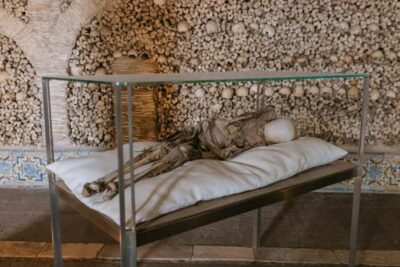
The Chapel of Bones is Évora’s most unsettling sight. Its interior walls and pillars are lined with human bones and skulls, said to represent more than 5,000 monks. An inscription at the entrance asks you to reflect on mortality, which sets the tone before you even enter.
The chapel is not for everyone. Some people find it memorable and thought-provoking, while others may find the display disturbing. Your visit lasts about 30 minutes, and the admission fee is not included.
The Chapel of Bones sits beside São Francisco Church, a larger and more traditional monument. Built between 1480 and 1510, the church combines Gothic and Manueline forms and reflects Portugal’s maritime expansion period.
Look for the cross of the Order of Christ and the emblems of King João II and King Manuel I. The church’s tall nave and ogival vault give it a strong sense of height. A 20-minute stop is brief but enough for a guided introduction.
This pairing works well because the two spaces create a sharp contrast. One is intimate, stark, and built around death. The other is grand, decorated, and linked to royal power and overseas exploration.
Same base, a completely different sort of day:
- 2-Hour Surf Lesson in Alentejo
★ 5.0 · 243 reviews - Évora and Monsaraz with Regional Wine Tasting from Lisbon
★ 4.5 · 229 reviews - Évora: Private walking tour with tickets to main monuments
★ 5.0 · 223 reviews - Private Day Tour With Guide to Évora and Monsaraz
★ 5.0 · 134 reviews
Praça do Giraldo and the churches of the old center

Praça do Giraldo is the city’s natural meeting point. Roads and lanes lead toward this broad square, named for Geraldo Geraldes, the figure credited with taking Évora from the Moors in 1167.
The stop lasts about 15 minutes, but you can use the square as a reference point for the rest of your walk. It is also near shops selling Alentejo handicrafts, including the kind of small local goods that are easier to browse when you are not tied to a large group schedule.
The Church of Graça adds another architectural style to the route. Founded in 1511 for Augustinian hermit monks, the church is a Renaissance monument with distinctive figures on its facade. Local people have long called these figures the Meninos da Graça, or boys of Grace.
The church is a short exterior-focused stop in the supplied route, so do not expect a long interior visit. Still, it helps you see how many different periods fit within Évora’s compact center.
The Roman Temple and Água de Prata Aqueduct

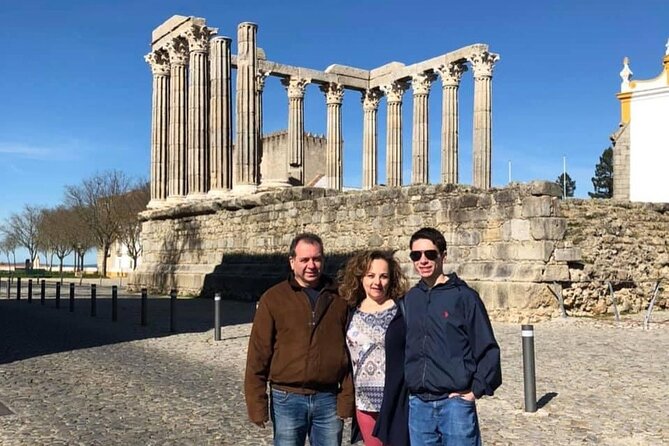
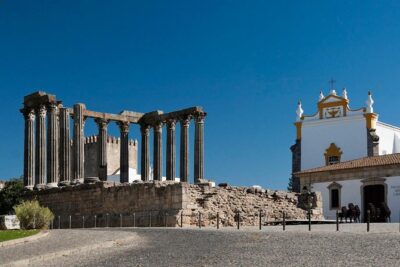
The Roman Temple, often called the Temple of Diana, is one of Évora’s most recognizable landmarks. Its columns make the Roman past easy to picture, especially because the temple sits near the cathedral and other major monuments.
The stop lasts about 15 minutes. That is enough for photographs and a clear explanation, but not for a long archaeological study. The Roman remains are part of a larger urban scene, not an isolated ruin outside town.
You will also see the Água de Prata Aqueduct, a Renaissance water system built during the reign of King João III. Designed by royal architect Francisco de Arruda and inaugurated in 1537, it carried water from springs near Graça do Divor to Évora over about 18 kilometers.
Some arches run outside the walls, while sections are visible within the city. The aqueduct helps explain how Évora supported urban life in the 16th century. It is also a good example of the practical side of history: this was not built merely for decoration, but to solve a daily need.
The aqueduct is listed as a stop without a fixed duration, so the exact viewing time may depend on traffic, weather, and the group’s interests. Ask your guide to point out the most useful section rather than expecting a long formal visit.
Climbing the cathedral and looking across Évora

The Cathedral of Évora is one of the day’s major monuments. Construction began in 1186, the cathedral was consecrated in 1204, and work continued until 1250. Its granite exterior shows the transition from Romanesque to Gothic design.
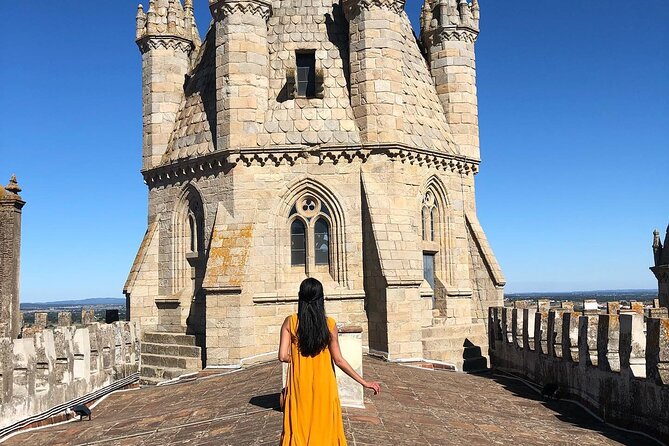
Two medieval towers frame the facade. The south tower holds the bells, and the entrance is decorated with 14th-century apostle sculptures attributed to Mestre Pêro. Above, the crossing tower and its stone-scaled spire form the building’s most distinctive feature.
The standard visit lasts about 45 minutes, and the entry fee is extra. Some groups have also climbed to the cathedral roof or tower for views across the city. That portion may depend on the day’s access and your timing, so ask your guide before counting on it.
The cathedral is a place where the private format pays off. You can spend more time on architecture if that is your interest, or keep the visit moving if churches are not your main reason for coming to Évora.
Diana’s Garden, lunch, and the value of flexibility

Diana’s Garden sits beside the Roman Temple and Largo do Conde de Vila Flor. It is a natural place to pause after the denser streets and interiors of the historic center.
Lunch is not included, but the guide can suggest or arrange a restaurant. Past outings have included traditional Portuguese meals, and the choice can be adjusted if you prefer a full sit-down lunch or a quicker bite.
That flexibility is one of the better reasons to choose a private tour. You can protect time for the cathedral, stop for photographs, or eat simply and keep exploring. In hot weather, your guide can also adjust the rhythm and make sure you are not walking nonstop through the middle of the day.
The private format does not mean every minute is completely open. The tour still has to cover the long return drive and scheduled monuments. But it gives you far more room to make sensible choices than a large group tour with a fixed lunch and rigid departure times.
Is $169.31 per person good value?
At $169.31 per person, the price is not a bargain day trip in the basic bus-tour sense. It becomes more reasonable if you value hotel pickup, a private vehicle, a private guide, and the ability to shape the day around your interests.
The price includes air-conditioned private transport, guide accompaniment, pickup and drop-off, compulsory insurance, and WiFi. It does not include lunch or monument entry fees, listed at about €10 per person for museums. You should add those costs before comparing the tour with a train journey and self-guided sightseeing.
For two people, the per-person price buys convenience and personal attention. For a larger private group, group discounts may improve the value. The tour is also useful if you are staying in Lisbon for a short time and want to see the Alentejo without arranging a separate overnight trip.
The value is weaker if you already have a car, enjoy researching sites yourself, and want to spend several days around Évora. In that case, the drive from Lisbon is still the same, but you may prefer to sleep in the city and explore at a slower pace.
Who should book this Évora day trip?
I would recommend it to couples, families, and small groups who want an easy day outside Lisbon without giving up personal attention. It suits people who like a mix of history, food, local industry, and architecture rather than a day devoted to a single monument.
It is also a good choice if you want explanations as you walk. Guides such as João and Anastasiya have been praised for making complicated history understandable, answering questions, taking photographs, and adjusting plans when needed.
You should think twice if you dislike long drives, need a slow schedule, or have mobility concerns that make old stone streets, steps, and cathedral access difficult. The tour is described as suitable for most participants, but the route includes walking through a medieval center and may include climbing stairs.
The outing is offered in English. Confirmation is provided at booking, and cancellation is free up to 24 hours before the start time. A minimum number of participants may apply, even though the activity itself is private for your group.
Should you book the private Évora and Alentejo tour?
Book it if you want Évora plus a distinctive introduction to Portugal’s cork industry, and if door-to-door transport matters to you. The cork factory, Chapel of Bones, Roman Temple, cathedral, aqueduct, and old center create a varied day rather than a simple monument checklist.
Skip it if you want to linger in Évora after dark or explore the Alentejo at a leisurely pace. An overnight stay would give you more time, but for a single day from Lisbon, this is a well-planned way to cover the city’s main sights while adding a genuinely local stop on the road.
FAQ
How long does the tour last?
The experience lasts approximately nine hours and begins around 8:30 a.m.
Where does pickup take place?
Pickup and drop-off are offered at your hotel, apartment, or cruise port in the Lisbon area.
Is the tour private?
Yes. Only your group participates in the private activity.
Is transportation included?
Yes. Private transportation in an air-conditioned vehicle is included, along with WiFi on board.
Is lunch included?
No. Lunch is not included, though the guide can help arrange or recommend a restaurant.
Are entrance tickets included?
No. Entry fees for monuments and museums are extra. The listed museum ticket cost is €10 per person.
Can I cancel for a full refund?
Yes. You can cancel at least 24 hours before the local start time for a full refund. Changes or cancellations made less than 24 hours in advance are not accepted for a refund.
The newest listings around Evora
- 2hr Walk in a Cork Forest★ 4.5 · 42 reviews
- Grande Prova Honrado Vineyards★ 5.0 · 46 reviews
- From Lisbon: Small-Group Day Tour to Évora and Monsaraz★ 4.6 · 54 reviews
- Évora (with Sé & Bones), Evoramonte & Arraiolos: From Lisbon★ 4.7 · 57 reviews
- Évora: Private tour with entrance tickets to main monuments★ 5.0 · 57 reviews
- From Lisbon to Alentejo: Évora and Megaliths Full-Day Tour★ 4.5 · 131 reviews
- Évora: Private walking tour, By Local Guide★ 5.0 · 87 reviews
- Marble Tour in Vila Viçosa★ 4.8 · 71 reviews
Evora Tours, compared.


Évora and Monsaraz with Regional Wine Tasting from Lisbon
Read our review →
Private walking tour with tickets to main monuments
Read our review →
Private Day Tour With Guide to Évora and Monsaraz
Read our review →
From Lisbon to Alentejo: Évora and Megaliths Full-Day Tour
Read our review →Browse the lists this tour appears in