

Reviewed · HISTORICAL TOURS
Lisbon: Jewish History in Portugal Guided Walking Tour
Lisbon’s Jewish story is not confined to one museum or monument. It is spread through Alfama, Baixa, and Chiado, where a guide connects old streets, archaeological traces, city views, and the long tension between acceptance and rejection. You’ll learn how Jewish communities helped shape Portuguese farming, finance, medicine, and the Age of Discoveries, then follow what happened after forced conversion and expulsion.
I like the way the tour places Jewish history inside the wider story of Lisbon, rather than treating it as a separate subject. I also like the human scale: guides such as Al and Luciano have tailored the pace and discussion to family heritage, modern Jewish life, and the group’s interests. The main caution is the terrain. This is a three-hour walk through hilly districts, so it is not suitable for people with mobility impairments.
Key points at a glance

- Alfama on foot: Explore one of Lisbon’s oldest neighborhoods while learning about earlier Jewish life and the city’s changing communities.
- Sephardic and Marrano history: Understand the difference between open Jewish identity, forced conversion, and the survival of Jewish customs in private.
- A wider Lisbon story: The walk links Jewish contributions to agriculture, finance, medicine, and Portugal’s 16th-century expansion.
- Personal guiding: Al and Luciano have led highly praised tours, with clear explanations and a willingness to adjust the pace.
- Views and physical effort: Expect a view toward the port, archaeological sites, a wall marked with a Star of David, and plenty of uphill walking.
- Simple logistics: Meet at A Padaria Portuguesa, bring comfortable shoes, and remember that transport is not included.
Why this Jewish history walk matters in Lisbon

This tour deals with a difficult subject without reducing it to dates and names. Jewish life in Portugal moved between welcome and rejection. At different times, Jews contributed openly to society, faced pressure to convert, and continued traditions under Catholic identities.
That tension is central to the experience. The tour introduces Sephardic Jews, the Jewish communities of the Iberian Peninsula, and Marranos, a term used in connection with Jews who converted to Catholicism, often under pressure, while some preserved Jewish practices privately. The story is not only about loss. It is also about adaptation, education, trade, and survival.
You’ll hear how Jewish residents contributed to Portuguese agriculture, finance, and medicine. The tour also links their work to the machinery of the Portuguese discoveries in the 16th century. That broader frame matters because it shows Jewish history as part of Portugal’s national story, not as a small side chapter.
The walk also follows the consequences of expulsion and conversion. Jewish people forced out of Portugal later became important in places including England, the Netherlands, and the United States. You are not simply looking at old streets. You are tracing how people, ideas, skills, and family histories moved across borders.
More Walking Tours in Lisbon
- Lisbon: History, Stories and Lifestyle Walking Tour
★ 4.8 · 10,902 reviews - Best of Lisbon Small-Group Guided Walking Tour
★ 5.0 · 4,869 reviews - Lisbon: Food and Wine Small Group Walking Tour
★ 4.9 · 4,082 reviews
Starting at A Padaria Portuguesa
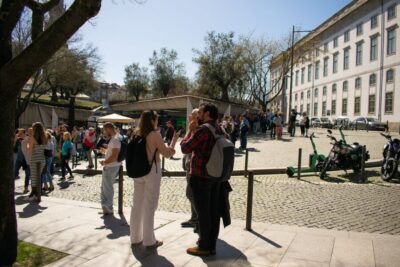
The meeting point is A Padaria Portuguesa, a bakery described for this tour as a bagel shop. It gives you a clear, public place to begin, but you should arrive with the name of the meeting point handy and check the starting time when booking.
The tour includes a guide and a bottle of water. Transport is not included, so you make your own way to the starting point and continue on foot for the full three hours. That arrangement keeps the experience focused and avoids spending part of the tour in a vehicle, but it also means you should plan around Lisbon’s hills and pavement.
The guides speak Portuguese and English. Al is frequently identified as a warm, clear guide who can adjust the pace to suit the group. Luciano has also led the walk, bringing a strong grasp of Portuguese and Jewish history and a personal interest in making the subject understandable.
Because the experience is guide-led rather than built around a large collection of displays, the quality of the explanation matters greatly. You will get the most from it if you ask questions and tell the guide at the start if your interest is family history, religious history, architecture, or Lisbon more generally.
Alfama and the shape of Jewish Lisbon

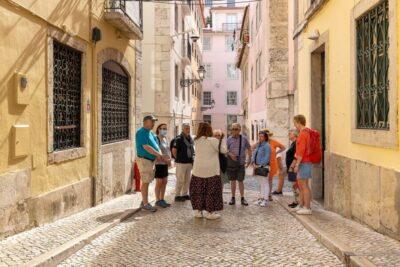
Alfama is the most physically demanding part of the walk and one of the most useful places to discuss older Jewish life in Lisbon. Its steep streets and layered buildings make the city’s past feel close, even when very little remains in a complete or obvious form.
Here, the guide connects the neighborhood to the condition of the Jewish community over time. You may hear about periods when Jews lived and worked openly, followed by periods when their position became uncertain. The point is not to pretend that every surviving wall has a clear Jewish label. Instead, the guide helps you read the neighborhood as part of a larger urban story.
The walk includes archaeological sites and references to former Jewish areas. One detail noted during the experience is a wall with a Star of David, a small but striking reminder of how Jewish identity appears in Lisbon’s streets. The tour is strongest when it explains such details in context rather than presenting them as isolated sights.
Alfama also offers city and port views. These are not just pleasant pauses for photographs. They help you see Lisbon as a maritime center, a place connected to trade, migration, and the wider world. That setting makes the discussion of Jewish commerce and Portugal’s overseas expansion easier to grasp.
Take the hills seriously. You may find the walk relaxing in pace, but it is not flat. Comfortable shoes, water, and a willingness to climb are more important here than dressing for a formal historical tour.
Baixa and the city rebuilt after disaster

The route also passes through Baixa, Lisbon’s central lower district. Here, the conversation can shift from older neighborhoods to the city’s wider development and the way public spaces changed over time.
Baixa gives the tour room to explain how Jewish history fits into Lisbon as a whole. The city’s commercial life, public institutions, and streets all help frame the work of Jewish communities in finance, medicine, agriculture, and trade. You are not only hearing about a minority community in isolation. You are learning how its skills and presence affected Portuguese society.
The contrast with Alfama is useful. Alfama feels steep, old, and intimate. Baixa is more open and planned, giving you a clearer sense of Lisbon as a center of government, business, and movement. The change in setting keeps the three-hour walk from becoming a single repeated conversation.
Baixa is also a practical point to consider if you tire easily. Even with a sensible pace, the full outing takes three hours and includes several neighborhoods. You should not book it as a casual stroll with no physical demand. The tour is best placed when you still have energy, rather than after a full day of walking around Lisbon.
More history walks in Lisbon:
- Lisbon: Live Fado Show with Port Wine in Historic Center
★ 4.7 · 4,166 reviews - Lisbon: Fado Show with Wine in a Historic Venue
★ 4.8 · 1,294 reviews - Explore Lisbon by Tuk Tuk: History and Viewpoints
★ 5.0 · 840 reviews - Lisbon: Daytime or Sunset Boat Cruise with History and Wine
★ 4.9 · 819 reviews
Chiado and the wider Portuguese story

Chiado adds another layer to the route. The tour uses the neighborhood to link Jewish history with the broader cultural life of Lisbon and Portugal. The emphasis is not simply on finding a surviving Jewish building. It is on understanding influence, memory, and the way later generations interpret the past.
This part of the experience can be especially useful if you want more than a narrowly religious tour. The guide discusses the influence of Jews on Portuguese culture and connects it to the city around you. You may also hear about how converted Jews and their descendants shaped later ideas about religious identity and acceptance.
The walk’s central question is uncomfortable but important: how do a society’s decisions about acceptance and rejection shape its future? The tour uses Portuguese Jewish history to examine that question, then connects it to the movement of Jewish communities after the 16th-century expulsion.
That wider approach explains why the experience includes more than Jewish sites. A guide such as Luciano can discuss general Lisbon history alongside the Jewish material, while Al has been praised for making connections between Jewish events and the periods of Portuguese history in which they occurred.
Guides Al and Luciano make the difference
A walking tour on a complex subject depends on the guide’s ability to explain, not just recite. Al has been singled out for his extensive subject knowledge, friendly manner, and ability to adapt the pace. One particularly useful feature is his willingness to shape the conversation around a participant’s Sephardic family ties.
Al has also added small personal touches, including Israeli dates purchased locally and a coffee or tea pause near the end of one outing. These details are not guaranteed parts of every departure, so treat them as possible extras rather than promised inclusions. Still, they show the kind of informal, personal approach that can make a history walk feel less rigid.
Luciano has also guided the tour. He has been described as passionate, well informed, and able to connect Jewish history with the story of Portugal and Lisbon. A guide substitution has also worked well in at least one departure, which suggests that the provider has more than one capable person handling the subject.
The tour is offered in Portuguese or English. If you have a specific interest in Marrano history, family records, modern Jewish life, or the role of Jews in the Age of Discoveries, say so early. Three hours gives the guide time to shape the emphasis, but not enough time to cover every subject at equal length.
What three hours feels like

Three hours is a sensible length for this topic. It allows the guide to explain the background, move through several districts, stop at physical traces, and make links to Portuguese history without turning the experience into a rushed checklist.
You should expect a steady walking tour rather than a sequence of long indoor visits. The supplied details identify the neighborhoods, archaeological sites, wall marking, and views, but they do not promise entry to a synagogue, museum, or other paid attraction. Book this for the interpretation and route, not for a long list of interior monuments.
The pacing has been adjusted to suit participants, and the walk can include a coffee or tea pause. Still, the hills remain. People with mobility impairments should not choose this activity, and anyone with knee or balance concerns should think carefully before booking.
The bottle of water is useful, but I would still start hydrated. Wear shoes with a firm sole. Lisbon’s older streets can be tiring over several hours, and the physical effort may distract from the history if you arrive unprepared.
Is $141 a fair price?

At $141 per person, this is not a budget city walk. The value depends on what you want from a guide.
If you simply want to pass through Alfama, Baixa, and Chiado, you can do that without paying for a tour. The price makes more sense if you want a specialist conversation that links street-level details to Sephardic history, Marrano identity, Portuguese society, and the international consequences of expulsion.
You are also paying for three hours of live explanation in English or Portuguese, not transportation or admission to a major attraction. That distinction matters. This is a premium guided experience based on interpretation, so it suits someone who would otherwise spend hours piecing together the story from scattered sources.
The value is stronger for people with Sephardic ancestry or a family connection to Portugal. Al has tailored the experience to that kind of interest, making the walk more personal than a standard city overview. It is also useful for anyone who wants Jewish history placed inside Lisbon’s general history rather than separated into a specialist lecture.
For a short city stay, the tour can save research time and give you a coherent starting point. For a strict budget, the cost may be hard to justify, especially since the walk includes no transport or paid site entry.
Who should book this walk?
I would recommend it to you if you want:
- A serious introduction to Jewish life in Lisbon and Portugal
- Context about Sephardic and Marrano communities
- A guide who can connect Jewish history with the Age of Discoveries
- A walking route through Alfama, Baixa, and Chiado
- Help exploring family or Sephardic heritage
- A small personal history experience rather than a standard sightseeing loop
You may want to skip it if you dislike hills, have limited walking ability, or are looking mainly for grand interiors and formal museum displays. The experience is about streets, explanation, memory, and connections.
The tour also works well early in a Lisbon visit if you want a historical frame for later sightseeing. You will see several central districts while learning why the city’s Jewish story cannot be reduced to one surviving monument.
Booking details to keep in mind
The experience lasts three hours and offers starting times based on availability. You meet at A Padaria Portuguesa, and you arrange your own transportation to and from the walk.
You can cancel up to 24 hours before the activity for a full refund. The reserve-now, pay-later option lets you hold a place without paying immediately, which is useful if your Lisbon schedule is still changing.
The activity has a 4.6 rating from 52 evaluations. The strongest pattern is clear: people value the guides’ subject command, their ability to explain the wider historical setting, and their willingness to adjust the pace. That is exactly what you should expect to matter most here.
Should you book the Jewish History in Portugal walk?
Book it if you want a thoughtful, guide-led look at Lisbon’s Jewish past and you are comfortable walking uphill for three hours. The best reasons to choose it are the route through Alfama, Baixa, and Chiado, the focus on Sephardic and Marrano history, and the strong guiding from Al and Luciano.
The price is high for a basic walk, and no transport or major admission is included. But if Jewish heritage, Portuguese history, or family roots are central to your visit, the personal explanation can make the cost worthwhile. Bring good shoes, arrive ready to ask questions, and treat the city itself as the main historical exhibit.
FAQ
How long is the Jewish history walking tour?
The tour lasts three hours.
Where does the tour meet?
You meet at A Padaria Portuguesa.
Which Lisbon neighborhoods does the route visit?
The route passes through Alfama, Baixa, and Chiado.
Is transportation included?
No. Transportation is not included, so you need to make your own way to the meeting point and continue on foot.
Which languages are available?
The live guide speaks Portuguese or English.
Is the tour suitable for people with mobility impairments?
No. The activity is not suitable for people with mobility impairments, and the route includes hilly walking.
What does the tour cover?
It covers Jewish culture in Portugal, the influence of Jews on Portuguese culture, Sephardic and Marrano communities, and the role of Jewish people in areas such as agriculture, finance, medicine, and the Portuguese discoveries.
Can I cancel for a refund?
Yes. You can cancel up to 24 hours in advance for a full refund. You can also reserve now and pay later.
The newest listings around Lisbon
- The Real Lisbon Street Art Private Guided Tour by Minivan★ 4.8 · 49 reviews
- Lisbon: Historical Walking Tour with Jeronimos Monastery★ 4.5 · 71 reviews
- Lisbon: Port Wine Tasting at Taylor’s Shop and Tasting Room★ 4.6 · 490 reviews
- Lisbon: Tagus River Cruise With Brunch★ 3.2 · 73 reviews
- South Lisbon: 3-Hour Christ the King Electric Bike Tour★ 4.8 · 97 reviews
- Oeiras Coast: Stand Up Paddleboarding near Lisbon★ 4.9 · 56 reviews
- Small Group Walking Tour of Belém★ 4.9 · 80 reviews
- Lisbon: 3-Hour Secret Food Tour★ 4.7 · 53 reviews
Historical Tours, compared.
Historical Sites, Wine Experience, Lunch & Cruise
Read our review →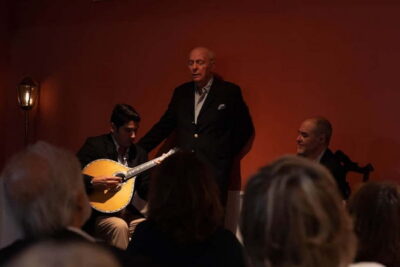
Live Fado Show with Port Wine in Historic Center
Read our review →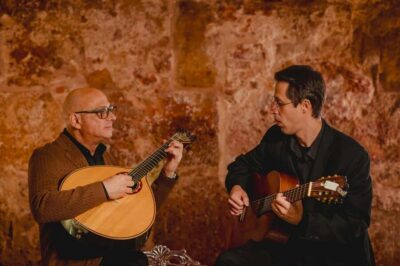

Browse the lists this tour appears in