Reviewed · ALGARVE TOURS
Cork Factory Tour & Cork Shop
Cork is far more than a wine stopper, and this one-hour factory visit shows why. You’ll follow the material from tree bark to finished product, watch workers grade and trim it, and see how boiling and flattening prepare cork for market. A guide such as Elena explains the work in clear English, with time for questions.
I like the live demonstrations, including cutting, grading, knife sharpening, and handcrafting. I also like the small shop, where you can buy Portuguese cork goods at what some visitors found to be better prices than local shops. The main catch is simple: this is a factory visit, not a cork forest tour, and there is no hotel pickup or public transport to the site.
Key points to know before you go

- See cork being graded and trimmed: Workers demonstrate how large and small pieces are assessed and prepared.
- Watch the boiling process: Huge water vats show how cork is softened and flattened before sale.
- Learn the full production chain: The tour covers harvesting, grading, processing, and the many uses of cork.
- Try cutting cork yourself: Some sessions give visitors a chance to handle the bark and make a cut.
- Shop for Portuguese cork goods: The small on-site shop sells items made from this natural material.
- Plan your transport carefully: You meet at Eco-Cork Factory near Faro, and hotel transfers are not included.
Why this short Faro tour is worth your time

Portugal is closely tied to cork, but most people encounter the material only after it has become a bottle stopper, handbag, coaster, or hat. This tour gives you the missing middle: the work between the tree and the finished object.
That change in perspective is the real value here. You see that cork is not simply peeled off and sent away. The bark must be harvested with care, sorted by quality, cut, boiled, flattened, and directed toward different uses. The result is a practical lesson in a Portuguese industry that many visitors otherwise pass without noticing.
The tour lasts about 1 hour and 10 minutes, with roughly an hour spent at the factory. That makes it easy to fit into a day around Faro, especially if you want an indoor activity that does not consume half your afternoon. At $21.17 per person, I consider it a fair buy for an organized introduction, demonstrations, and access to the production area.
You should not expect a large museum, polished visitor center, or full day in the countryside. The factory is a working industrial site, and one visitor found the premises plain. That is part of the appeal for some people, but it also means the experience is more practical than theatrical.
A few more Faro options worth putting side by side
- 4 Stops | 3 Islands & Ria Formosa Natural Park – From Faro
★ 5.0 · 3,080 reviews - From Faro: Benagil Cave, Marinha Beach, Algar Seco & More
★ 4.7 · 2,027 reviews - Ria Formosa – Boat trip to the 3 Islands: Armona | Culatra Island | Lighthouse
★ 5.0 · 1,872 reviews
Finding Eco-Cork Factory near Faro
You meet at Eco-Cork Factory, also shown as Eco-Fábrica de Cortiça, at Sítio da Mesquita Baixa, Francisco Carrusca, 8150-048, Portugal. The start time is 11:30 am, and the tour ends back at the same place.
The meeting point matters because hotel pickup and drop-off are not included. There is also no public transportation to the factory, so you need to arrange your own way there. A car is the most straightforward choice, though the supplied information does not specify taxi costs or driving time from central Faro.
I would not leave transport planning until the morning of the visit. Check the address carefully, allow time to reach the factory, and keep the confirmation on your phone. The mobile ticket makes entry simple once you arrive.
The group can include up to 30 people. That is still a manageable size for a small factory, though sound may become an issue if the group fills up. One person found the presentation hard to hear when the group was large and suggested a microphone would have helped.
Starting with cork trees and harvesting

The first part explains where cork comes from and how it is collected. You learn about the bark itself, the markings used on trees, and the work required to remove the outer layer without destroying the tree.
That last point gives the visit its environmental angle. Cork is a natural material, and the tree remains part of the story after the bark is removed. The tour presents cork as a resource that can be harvested and used in many forms, rather than as a disposable industrial product.
If you have already visited a cork farm, this factory tour makes a useful second stop. One visitor had seen the trees first and found the factory visit a helpful look at what happens afterward. If you have not seen a cork field, keep your expectations in check: the activity takes place at the factory and does not include a first-hand harvesting visit in the grove.
The explanation covers the different grades of cork. That is important because not every piece is suitable for the same job. The quality and shape of the bark affect whether it becomes a stopper, a decorative item, a household object, or another manufactured product.
Watching workers grade, trim, and shape the bark
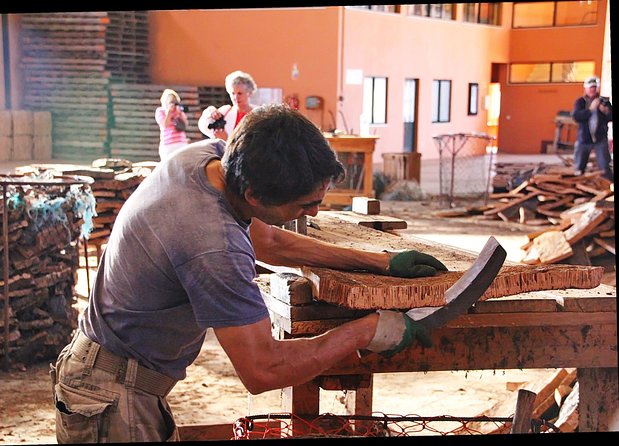
The factory floor is where the tour becomes more concrete. You see workers examine cork, trim it, and sort large and small pieces. This is careful, skilled work, and it helps explain why cork production is more labor-intensive than a finished souvenir suggests.
A live demonstration may include cutting and grading. Some visitors also get the chance to cut a piece of cork themselves. That small hands-on moment is especially useful for families because it turns an abstract explanation into something physical and easy to remember.
There is also a demonstration of knife sharpening, described as an impressive part of the visit. A cork assessor may show how a handcrafted bowl is made, giving you a closer look at the judgment and handwork involved in shaping the material.
I like this section because it keeps the focus on people and technique. Machines matter, but the tour also shows the trained eye behind the process. You begin to see why two pieces that look similar at first can have different values and different uses.
The factory is not presented as a show built only for tourists. You are looking at a working operation, so the setting may feel plain or even rough around the edges. If you want polished displays and a café-style finish, you may find it underwhelming. If you want to see real production work, the setting gives the tour some honesty.
Same base, a completely different sort of day:
- Ria Formosa Natural Park and Islands Boat Cruise from Faro
★ 5.0 · 1,314 reviews - 2 Stop | 2 Islands & Ria Formosa Natural Park – From Faro
★ 5.0 · 1,045 reviews - Faro: Deserta Island and Farol Island Catamaran Boat Trip
★ 4.6 · 955 reviews - From Faro: Benagil, Algar Seco, 7 Hanging Valleys, & Marinha
★ 4.9 · 890 reviews
The boiling vats and the road to finished cork
One of the most striking practical details is the set of large water vats. Cork is boiled and then flattened before it is sold on to other factories or used in later stages of production.
This is the point where many visitors gain a better sense of the process. A cork stopper looks simple, but the bark has already passed through several stages before it reaches a manufacturer. The tour explains how boiling changes the material and how the grade helps determine its next purpose.
The presentation focuses strongly on cork stoppers, which makes sense because they are one of the best-known products. Still, the larger lesson is that cork has many uses. You may see or hear about items such as bowls and other goods in the shop, along with the wider range of products made from different grades of cork.
One small limitation is that the tour does not appear to cover every modern substitute in equal detail. A question about synthetic cork products was not answered accurately during one visit. If that subject matters to you, ask directly, but treat the main strength of the experience as its explanation of natural cork production.
A small shop with practical souvenirs
The final stop is the Cork Shop at the factory. It is not a large retail space, but it offers a chance to see finished cork goods after learning how the material is prepared.
The selection can include attractive small gifts and useful objects. Cork is light, easy to pack, and strongly connected with Portugal, so this is a better place to choose a souvenir than a generic airport shelf. Some shoppers found the quality good and the prices lower than those in local shops.
The shop also gives you a chance to judge the material with new eyes. After seeing raw bark, grading, trimming, and flattening, a finished item feels less like a novelty and more like the last stage of a long process.
Do not count on food or drinks as part of the visit. They are not included, and one person felt the experience would have ended more pleasantly with a drink in a comfortable room. I would plan to eat before or after the tour rather than expect refreshments at the factory.
How the guides explain the work
The English presentation is one of the strongest parts of the experience. A guide named Elena is specifically associated with the tour, and the information supplied describes her as clear and personable. Other sessions may have a different guide, but the format allows time for questions.
The best approach is to ask as you go. You can ask about tree markings, grades, harvesting, boiling, cutting, or the products made from cork. The tour is not just a walk past equipment. The guide explains what you are seeing and connects each stage to the next.
A short video may be included before the walk around the factory. It introduces the subject, then the guide adds explanations and demonstrations in person. The video can be helpful, though sound conditions may vary. Heavy rain once made it difficult to hear the presentation, and a full group may also affect clarity.
If you have hearing concerns, stand close to the guide and ask to be positioned where you can see and hear the demonstration. That is sensible advice for any factory tour, particularly one where machinery or weather can create background noise.
Is $21.17 a fair price?
At $21.17, you are paying for a focused introduction rather than a long excursion. There is no transport, meal, farm visit, or extended shopping period included. The price makes the most sense if you value the explanation, access to the working factory, and live demonstrations.
I would call it good value for families, curious adults, and anyone already interested in Portuguese cork. The tour adds meaning to souvenirs and gives you a better grasp of a major local industry. It is also a useful option on a rainy day because the experience is indoors.
The value is less clear if you expect a full rural day or a visit to the cork trees themselves. The tour does not take you into a cork field, and it ends after about an hour. One person considered it too short, while another found the compact format ideal. Your choice depends on what you want from the visit.
The small shop improves the overall value if you plan to buy cork goods. You are not required to purchase anything, but the chance to compare products at the source is useful.
Who should book this factory visit?
I would recommend it to families because children can see the material being cut and, in some sessions, try it themselves. The subject is easy to grasp, and the tour has enough moving parts to hold attention without lasting all day.
It also suits adults who prefer working places to formal museums. You see actual tools, vats, bark, and production steps. The setting is not luxurious, but it feels connected to the trade.
This is a good follow-up for anyone who has visited a cork farm. The farm shows the living trees; the factory shows what happens next. Taken together, the two experiences explain the full chain from bark to product.
I would hesitate if you have limited mobility or need a highly polished venue, since the supplied information does not describe the factory layout in detail. Child seats are available on request if you provide that information when booking, and service animals are allowed. Most people can take part.
Practical details before booking
Confirmation is provided when you book, and the mobile ticket is convenient. The tour is offered in English. The maximum group size is 30, so you may want to arrive ready to stand near the guide if the group is full.
Free cancellation is available up to 24 hours before the start time for a full refund. Changes or cancellations made less than 24 hours before 11:30 am are not accepted for a refund, and the cut-off follows local time.
Bring your questions. The most rewarding parts of the visit come from connecting the demonstrations to the bigger process. Ask how grades differ, why cork is boiled, what the tree markings mean, and how the material becomes a finished object.
Should you book the Cork Factory Tour?
Book it if you want a short, clear look at an important Portuguese industry and you can arrange transport to the factory. The hands-on cutting and grading demonstrations, the boiling vats, and the chance to shop for cork goods make it more useful than a simple gift-shop stop.
Skip it if your main goal is to walk among cork trees, enjoy a long countryside outing, or finish with food and drinks. For everyone else, the price is reasonable, the English explanations are accessible, and the factory gives you a fresh appreciation for a material you probably use without thinking about it.
FAQ
Where does the cork factory tour begin?
It begins at Eco-Cork Factory, also called Eco-Fábrica de Cortiça, at Francisco Carrusca, Sítio da Mesquita Baixa, 8150-048, Portugal.
What time does the tour start?
The tour starts at 11:30 am.
How long does the experience last?
The experience lasts approximately 1 hour and 10 minutes. The factory visit itself is listed as about one hour.
Where does the tour end?
The tour ends back at the factory meeting point.
Is the tour offered in English?
Yes. The experience is offered in English.
Is hotel pickup included?
No. Hotel pickup and drop-off are not included, so you must arrange your own transport to and from the factory.
Is public transportation available to the factory?
The supplied information states that there is no public transportation to the factory.
Can children participate?
Most people can participate, and child seats are available on request if you provide that information when booking.
Can I cancel for a full refund?
Yes. You can cancel at least 24 hours before the local start time for a full refund. Cancellations or changes made less than 24 hours before the start are not accepted for a refund.
The newest listings around Faro
- From Faro: Benagil Hiking Cliffs and the 4 Treasure Experience★ 5.0 · 424 reviews
- Highlights & Hidden Gems of Faro Private Tour★ 5.0 · 78 reviews
- Tavira Tuk Tuk Tour – Chocolate Tour – Tavira City & Chocolate★ 5.0 · 63 reviews
- Tuk tuk Tour Tavira Total – 2h00 – Includes Tuna Museum and Fishing Village★ 5.0 · 71 reviews
- Tavira Olive Experience Factory Tour and Tasting★ 5.0 · 190 reviews
- Group Surf Lessons★ 5.0 · 73 reviews
- Tavira City Tuk Tuk Tour – 1h Tavira City Tour★ 5.0 · 100 reviews
- 2 Hours Boat Tour in Ria Formosa★ 4.0 · 42 reviews
Algarve Tours, compared.

Benagil Caves Speed Boat Tour with Sunset Option
Read our review →

Benagil Caves & Dolphin Watching Speed Boat Tour
Read our review →
Dolphins Search and Benagil Caves from Albufeira
Read our review →
Coastline and Benagil Caves Tour by Catamaran
Read our review →